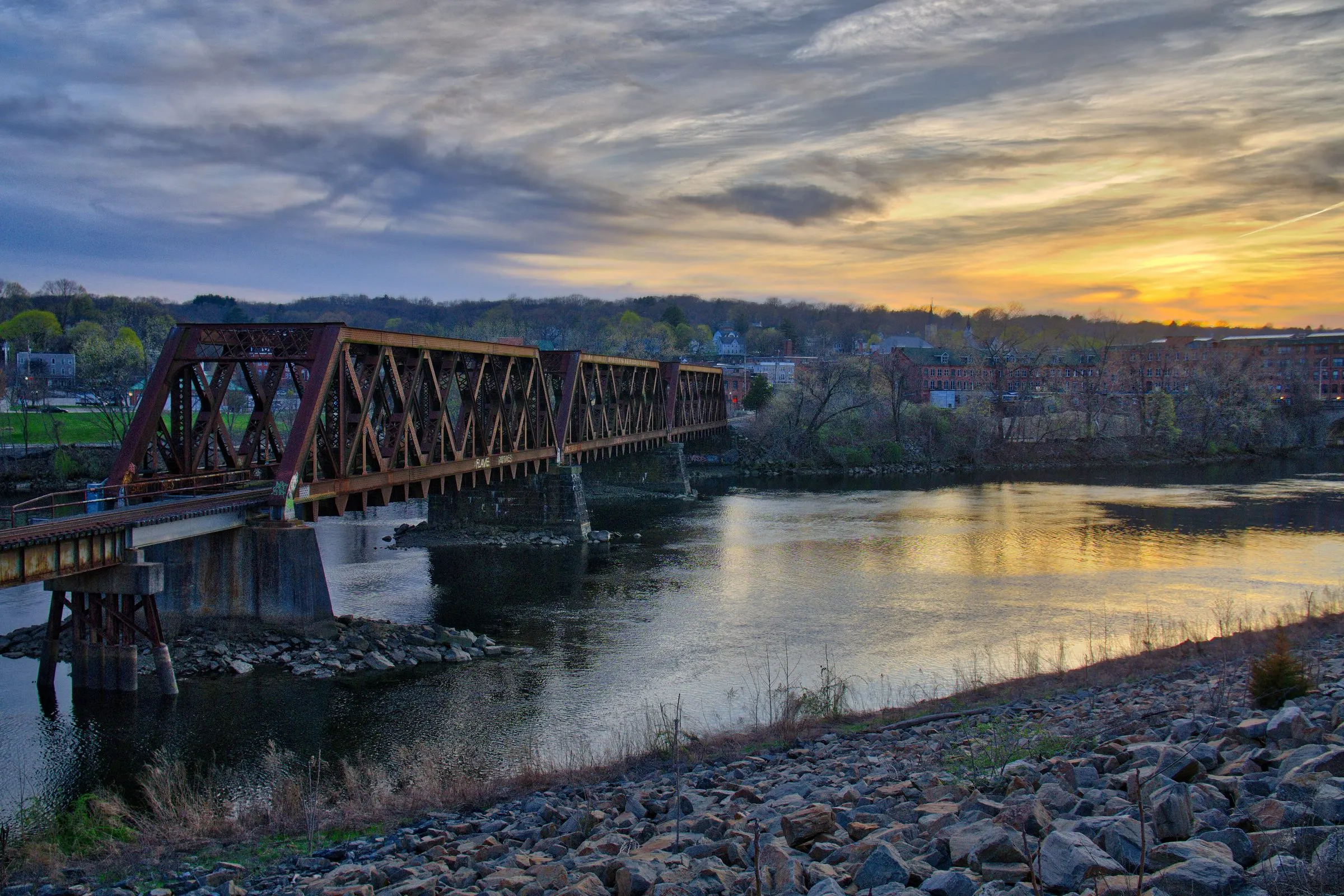
The things that decide what a house here is likely to need: geology, water, flood exposure, housing eras, and environmental history.
The Victorian housing stock
Derby built its best houses during the boom that ran from the mid-nineteenth century into the early twentieth, and they are still here in quantity. Slate and layered roofs, elaborate porches and trim, fieldstone and rubble foundations, tall unlined chimneys, original wiring in the walls, and very often a conversion history where a single-family became two units and then three. Each of those is inspectable, and each of them is where the money is.
Two rivers and the flood of 1955
In August 1955 hurricanes Connie and Diane arrived days apart, the Housatonic and Naugatuck both overflowed, and the resulting flood was the worst natural disaster in Connecticut history. Derby, sitting at the confluence, was hit as hard as anywhere in the valley. Everything about the way water is managed here today follows from that week.
The levee system, and what "protected by levee" actually means
The U.S. Army Corps of Engineers built a system of levees and floodwalls along part of the Housatonic and the entire west bank of the Naugatuck in Derby during the 1960s and 1970s, extending north into Ansonia. The Naugatuck levee was recertified in 2010 and the land behind it is mapped as "Zone X — Protected by Levee." That designation means most owners there are not required to carry flood insurance. It does not mean the risk is zero: residual risk from a larger-than-design event, or from a failure, remains, and the city's own plan notes the system is in good condition but ageing and manually operated. Understanding which side of that line a house sits on is one of the more valuable things a buyer here can learn.
Bedrock, faults, and hillside lots
Derby sits on schist, granulite, and gneiss cut by old thrust faults, including the inactive East Derby Fault running northeast to southwest east of Route 8. What matters day to day is the topography that geology produced: steep streets rising from the rivers, retaining walls of every era and quality, and drainage that always has somewhere downhill to go, often toward the house below.
A fully served city
Unlike most of the towns around it, Derby is comprehensively served: public water from the Regional Water Authority and the Aquarion East Derby system, and public sewer through the city. That takes well and septic questions off the table and puts the focus back on the building itself.
Radon in a Zone 1 county
New Haven County is EPA Zone 1, the highest-potential category, based on a predicted county-wide average above 4 pCi/L. Old houses with fieldstone foundations and stone or dirt-floored cellar sections behave differently than newer construction, and there is no way to predict a given basement without measuring it.